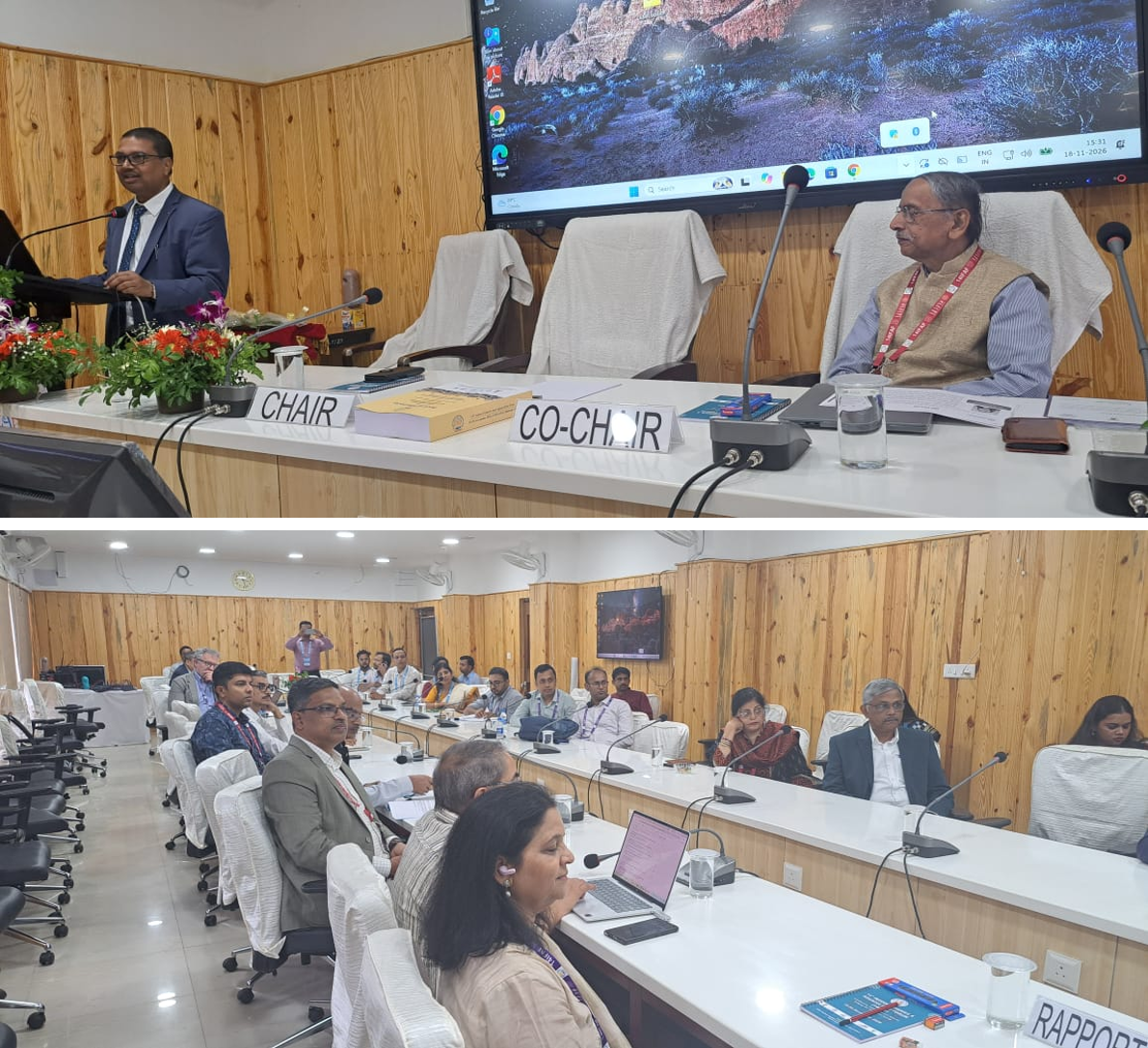
FAO REFERENCE CENTER SPECIAL SESSION ON “GENOMIC SURVEILLANCE OF ANTIMICROBIAL RESISTANCE IN ONE HEALTH CONTEXT”

About
FAO Reference Center, Nitte University and ICAR Indian Network for Fishery and Animal Antimicrobial Resistance (ICAR-INFAAR) jointly organized a Special Session on “Genomic surveillance of antimicrobial resistance in one health context” at the 14th Indian Fisheries and Aquaculture Forum held at the Central Institute of Freshwater Aquaculture, Bhubaneswar on November 18, 2026. Dr. J. K. Jena, Deputy Director General, ICAR chaired the session and Dr. Iddya Karunasagar, Advisor, Nitte University served a co-chair. In his opening address, Dr. Jena explained about the ICAR Network project INFAAR and the continuing threat of emergence and spread of antimicrobial resistance. He highlighted the need to strengthen the network and develop strategies to mitigate antimicrobial resistance. Dr. Iddya Karunasagar emphasized the need for genomic surveillance, which would be essential to understand pathways of dissemination and spread of antimicrobial resistance in different sectors. Mr. Ken Shimizu, FAO Representative in India Ad Interim delivered the opening remarks highlighting the need for different sectors and adopt one health approach to minimize the emergence and spread of antimicrobial resistance.
Dr. Carmen Espinosa Gongora from Danish Technical University, National Food Institute delivered an online talk. She highlighted the emergence of carbapenemase producing Enterobacterales in European Union in the food chain notwithstanding that carbapenems are not used in veterinary sector in EU. She explained about the EU funded CarbaRales project that generates genomic data on Enterobacterales from cattle, pig, poultry and bivalves in EU to understand the transmission of resistance determinants for carbapenems in the EU. Dr. Neelam Taneja from Postgraduate Medical Education and Research (PGIMER), Chandigarh spoke on genomic surveillance of antimicrobial resistance in the medical sector. She explained how genomic information helped identification of pigs as main source of non-typhoidal Salmonella. She noted that Ciprofloxacin-resistant S. Kentucky ST198 carried identical QRDR mutations and SGI1-borne resistance in humans, chickens and goats; poultry S. Typhimurium ST19 harboured an IncFIB(S) plasmid related to pSLT-BT, the virulence plasmid of invasive ST313 in Malawi. Dr. Chaitanya Joshi, former Director of Gujarat Biotechnology Research Center provided insights into methodology and tools available for whole genome sequencing and analysis of genomic information. He explained that The strategic integration of Whole Genome Sequencing (WGS), shotgun metagenomics, and ARG (Antimicrobial Resistance Gene)-targeted amplicon sequencing, complemented by Single Nucleotide Polymorphism (SNP) analysis and functional validation, offers a robust framework for actionable, evidence-based genomic surveillance of AMR.
Dr. Sabu Thomas, Director, Center of Excellence in Microbiome (COEM), Trivandrum spoke about understanding the AMR at microbiome level. He noted that detection of drug-resistant commensal bacteria in the infant gut microbiome prompted investigations into the impact of maternal postpartum antibiotic prophylaxis on the infant microbiome and resistome, highlighting potential unintended consequences of antibiotic exposure and the need for judicious antimicrobial use. He informed that COEM has identified a genome-sequenced, infant-gut-derived probiotic candidate with promising activity against the major MDR pathogens, including colistin-resistant K. pneumoniae.
Dr. Gaurav Rathore from ICAR–National Bureau of Fish Genetic Resources (NBFGR), Lucknow, presented updates on ICAR-INFAAR activities in the fisheries and aquaculture sector. He highlighted the progress of the Project focusing on systematic surveillance of AMR in aquaculture environments and farmed fish. He explained that the project has set up a network of 31 centers in ICAR Institutes and State Agriculture Universities. All participating institutions follow Standard Operating Procedures for isolation and susceptibility testing of bacteria. He noted that integrated validated data management software WHONET is used along with FAO ATLASS tool to ensure that date meets international reliability benchmarks. Dr. Samiran Bandyopadhyay from ICAR–Indian Veterinary Research Institute (IVRI), Eastern Regional Station, Kolkata, presented updates on ICAR-INFAAR activities in the veterinary sector. He highlighted the network's efforts towards strengthening AMR surveillance across livestock and poultry production systems through systematic bacterial isolation, pathogen identification and antimicrobial susceptibility testing. He discussed the importance of monitoring priority bacterial pathogens (eg Methicillin resistant Staphylococcus, ESBL producing Escherichia coli) and generating evidence on their antimicrobial resistance profiles to understand the emergence and dissemination of resistance in animal populations.
Dr. Krishna Kumar from Nitte University explained about integrated CRISPR spacer profiling, pangenome analysis, genome-wide association analysis, and comparative assessment of antimicrobial-resistance determinants, mobile genetic elements, genomic islands, and lineage-specific gene variation to identify genomic features associated with aquatic and clinical populations of Streptococcus agalactiae. He noted that the findings from these analyses provided insights into the evolutionary dynamics and host-associated genomic diversification of ST7-Ia. Dr. Deekshit from Nitte University explained that the interplay among antibiotic exposure, host-associated environmental stresses, and bacterial fitness, with particular emphasis on E. coli, K. pneumoniae, and non-typhoidal Salmonella strains. Concluding the session, Dr. Indrani Karunasagar, moderator of the session emphasized the complexities involved in the emergence and dissemination of antimicrobial resistance and recommended that human, animal, plant and environment sectors should work together to understand and mitigate antimicrobial resistance.
News Date : 2026-11-26
Last updated 2026-11-26 08:29:07